· By Buffy
Anatomy 5: The Balance Assembly
The oscillator that actually keeps time: balance wheel, hairspring, jewels, and the adjustment screws that let a watchmaker negotiate with physics.
Part 5 of 8 in the Anatomy series.
If you could keep only one assembly from the whole watch, keep this one. The balance assembly is the timekeeper; everything else is support.
The balance wheel
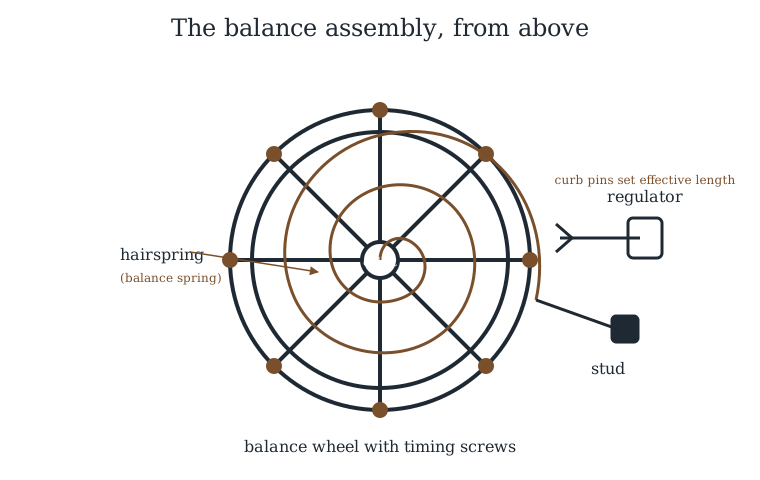
A weighted wheel on a staff, mounted between two jeweled bearings, free to rotate back and forth. Its period depends on three things:
- Moment of inertia (mass distributed around the rim),
- Spring strength (the hairspring’s torque per degree),
- Geometry luck (the wheel must oscillate, not wander).
Adding weight to the rim slows it down; moving weight inward speeds it up. Timing screws (or small weights on free-sprung balances) let the watchmaker adjust the wheel’s inertia precisely — that is what “adjusting in positions” ultimately manipulates.
The hairspring
The balance spring is the flat spiral of exotic alloy above the wheel. It is the second-most important invention in horology after the pendulum: without it the balance would oscillate at a rate that depends on how hard it was pushed (a property called isochronism failure, discussed here) — with it, the period is governed mainly by the spring itself.
The spring’s outer end is pinned to the stud; the inner end coils around the collet on the balance staff. Between them sits the regulator — an index with curb pins that changes the spring’s effective length to speed the watch up or slower it down. Free-sprung watches omit the index entirely and adjust by timing weights alone: fewer moving parts, better stability, harder to service.
Shock protection
The balance staff pivots are absurdly thin — thinner than a hair — and a drop would snap them instantly. Shock settings (Incabloc, KIF, Paraflex, Diashock) mount the jewel bearings in spring-loaded cups: a shock lets the jewel move a fraction of a millimeter and return. Introduced in the 1930s and one of the quiet reasons the wristwatch became survivable. See Shock protection for the details and limits.
The roller and impulse jewel
Under the balance sits the roller table carrying the impulse jewel — the little ruby tongue that engages the pallet fork once per swing. Its height, depth, and the roller’s safety action (roller dart and fork’s safety pin) guarantee that the fork can only be thrown when the balance is actually coming to give it impulse — a knocked wrist otherwise couldn’t double-unlock the escapement.
The whole, in one sentence
A mass on a spring, isolated from the world on jeweled pivots, exchanging a pinch of energy with the escapement twice per period, counting 86,400 beats a day to within a few seconds.
That last number — the rate — is where watchmaking stops being assembly and starts being adjustment. Next, though: The Keyless Works.